Free broadband. That is the wave sweeping UK right now.
A few years back, people were offered free dialup Internet connection in UK. But you paid for the phone calls. Why would the Internet Service Providers (ISPs) offer Internet for free? What was there in it for them?
This could work because the ISPs bought bulk telephone time from British Telecom (BT), and asked BT to bill the customers using the Internet connection on the normal billing mode for those minutes which they used for connecting to Internet with that particular ISP.
Sounds confusing? This is how it works.
Freeserve was the first company in UK which offered this service. Until this company was set up in 1998, Internet access in UK was metered. One had to pay the costs of both the telephone calling time plus the ISP's charges per minute - something similar to what it is now in India. All that Freeserve did was to do a deal with BT and promised that its customers will call Freeserve's numbers at least one million minutes every month (say), and negotiated a price for the same (say 10p a minute), and guarantee this payment to BT whether or not Freeserve's customers utilised these many minutes or not each month. What BT will guarantee in turn is that it will charge its customers calling Freeserve's numbers the normal rate (say 25p per minute) and will pay that amount to Freeserve. Thus, the differential 25p - 10p = 15p per minute was what Freeserve was getting for providing its services.
Thus BT banked on Freeserve's marketing ability and innovative service it was offering its customers to make money. Freeserve was making its money by banking on the increasing demand for Internet dialup connectivity.
But this did not last long. More and more companies jumped in the fray making similar offers. The per minute call rate kept falling in UK, thus squeezing the differential. Some competitors offered flat rate deals for unlimited time.
Then BT started offering DSL services and that almost completed wiped out the above business model. DSL is of course an excellent model. It doesn't clog up the local loop allowing one to make a phone call as well as an Internet data transfer simultaneously. But BT had an undue advantage. Only BT owned bulk of the local loop across the country. BT could take its own sweet time to offer DSL to specific areas. If someone had to challenge BT, they had to start laying their own lines, copper lines or fibre optic lines or coaxial cable or something else.
Then, the telecom regulator in UK (Ofcom) started looking at unbundling the local loop. This proposal - despite resistance from BT - was accepted by the Government and the roll-out process is going on now.
Thus we now have the rush from innovative companies looking at offering free Broadband connectivity. Pure mobile phone operators as well as Cable and/or DTH Television players have also decided to offer a free broadband deal for their existing customers.
The convergence game in UK is far more interesting than anywhere else in the world. UK, for long, had a virtual mobile service model in place. Virgin Mobile (which is merging with NTL - cable TV operator who is also offering telecom services) was one such. It was using T-Mobile's platform to offer its branded services. The 'Freeserve' type model emerged only in UK. The ground situation in USA is very different that some of these models could not have developed in USA.
Now, let us take a look at the situation in India.
The landline in India is still dominated by government owned BSNL and MTNL. These companies have not looked at selling bulk minutes to any third party operator so far. Thus, Freeserve like model has not emerged in India. We have jumped straight to the DSL revolution. But BSNL and MTNL resist local loop unbundling, though the Indian regulator TRAI suggested this. BSNL and MTNL have strong Government backing. The Department of Telecommunication and the Minister for Telecom Dayanidhi Maran have strongly defended not unbundling the local loop. We will never get to see local loop unbundling in the next 5 years or so.
The mobile phone sector in India is booming. Thus no mobile phone operator has bothered to look at interesting models such as virtual mobile service. BPL talked about it at some point in time, but has since been taken over by Hutch.
India is probably looking towards a Wi-Max driven revolution to unshackle the broadband market and Internet connectivity.
The connectivity costs have come down. Airtel offers a Rs. 600 a month, unlimited download, but a restricted 128 kbps DSL connection. Certain other deals from Airtel offer connectivity at about Rs. 200 a month. BSNL offers similar services. None of the operators will be interested in offering higher bandwidth, higher quality of service for a while anyway. The TV distribution platforms have not shown any initiative in offering high speed Internet connection. Reliance has talked a lot, but is far from delivering an integrated triple-play or quadruple-play solution.
At times, a booming market by itself turns out to be bad for the customers. The service providers have little time to think of innovative and interesting solutions. They keep working hard, just to handle the massive demand for the basic services!
Wednesday, June 07, 2006

Thursday, June 01, 2006
Chennai - Healthcare Capital of India?
I do not have any data. This is based on my personal observation over the last 4 months - during which time I visited Ramachandra Medical College Hospital, Apollo Hospitals, MV Diabetes Centre and Shankara Nethralaya in Chennai.
In each of these hospitals, I noticed a huge crowd, but what was interesting was the presence of patients who spoke Malayalam, Telugu, Hindi, Bengali and a few other assorted North Indian languages. In each Hospital, the staff were equipped to deal with the patients who could only speak in the above languages. The staff were all - or almost all - Tamilians but they spoke perfect Bengali, Hindi, Malayalam, Telugu and what not besides Tamil and English.
In Apollo where my father underwent a heart bypass surgery, I found NRIs from Malaysia and USA. I also found a few Africans and Caucasians (not sure of their nationalities). In and around Apollo Hospitals in Greams Lane, I found plenty of Malayali and Bengali patients staying in temporary accomodations.
I thought that the facilities for something as complex as heart bypass surgery are perhaps not widespread and perhaps Chennai has over the years built up sufficient number of private hospitals that specialise in heart surgery. But when I went to Shankara Nethralaya, I found several people who seem to have clearly come from North India and from Bengal for something as simple as an eye checkup and proper prescription of glasses. This is difficult for me to understand. Surely there should be enough eye hospitals around the country? It was strange to see the staff at Shankara Nethralaya talking to the patients in perfectly acceptable Bengali and Hindi. Unless the stream of visitors is large, the staff wouldn't have taken the effort to learn these languages.
So what is actually happening? Does anyone know?
As an aside, I wonder if people in North India will take the effort of learning Tamil or Telugu to talk to their customers.
Tuesday, May 30, 2006
The IIT-K letter and my comments
I received a copy of the letter written by 125 faculty members of IIT Kanpur to the President of India and the Prime Minister of India.
I respect the faculty members of IIT Kanpur. They are all accomplished individuals. However I must say that I was disappointed with the letter. I could only sense a mood of desperation in it. They seemed to be in a hurry and panic and hence did not think through sufficiently each of the points they had raised in that letter.
Here below, I have tried raising some of the points I disagree with in the letter. The quotes from the letter are all in italic. The rest are my responses. I was asked to quote the letter in full so that readers can make up their own mind. I have therefore posted the entire letter as a separate blog post.
"The undergraduate students of IIT Kanpur do not usually, or even often, come from wealthy and privileged backgrounds. The vast majority come from the smaller metropolises like Kanpur, Patna and Allahabad, or cities like Bareilly, and the moffasil towns and villages of Uttar Pradesh and Bihar. A typical example is the late Satyendra K Dubey, an IITK alumnus, whose murder in 2003 while working on the National Highway project got national media attention. He came from a small village in Bihar."
I studied B.Tech Mechanical Engineering in IIT-Madras between 1987 and 1991. I was from Nagapattinam. In the graduating class of '91 in IIT-Madras, I could locate only 10 people or so from the whole of Tamil Nadu outside of Chennai. These people were from Madurai, Coimbatore, Vellore and Trichy. No one went to IIT from Nagapattinam before my time. No one has gone to an IIT since my time. The bulk of the students - over 90% - who qualify for IITs from Tamil Nadu continue to come from Chennai.
I reckon that over 70% of students who get into IITs come from large metropolitan cities. The percentage could be more. I refuse to believe that "the vast majority come from the smaller metropolises like Kanpur, Patna and Allahabad, or cities like Bareilly, and the moffasil towns and villages of Uttar Pradesh and Bihar." I find it a wild claim, not supported by what I saw between 1987-1991.
"Most IIT Kanpur students thus overcome poverty, bad schools, and many adverse circumstances to compete in a gruelling entrance examination for the right to be here."
The way IIT JEE is structured, it is very difficult to get into IITs overcoming "bad schools" or "adverse circumstances". Nor is it easy to overcome "poverty".
"Backwardness is not determined by caste alone. It is clear for all to see that other factors like poverty, region and gender have greater adverse impact on the chances of a person becoming an engineer or a doctor. [...] However the point we wish to make here is not to argue for one set of criteria for reservations over others. Rather it is to argue that the best institutions in India should be the preserves of excellence, with proven performance as their only selection criterion."
Despite agreeing that backwardness is created by caste, poverty, region and gender, the professors believe that nothing is to be done to improve the backward lot, and that "best institutions in India" select people only based on performance as the sole selection criterion. But then they go on to say:
"Even if Government insists on affirmative action programs for IITs, we are sure that the IITs can be trusted to evolve and implement such programs by themselves."
That is, IITs will look at an affirmative action program only if the Government insists, and not on its own. Given the antipathy towards caste based reservation as demonstrated by this letter, and the attitude of "performance as the sole selection criterion", can one trust IITs "to evolve and implement [affirmative action] by themselves"?
While I agree that affirmative action is not exactly equal to numerical quota, it is certainly not selection based only on proven performance. IITs have to agree to an aggressive "affirmative action" policy. If they want to be taken seriously, they have to propose their affirmative action plan. The statement "After all, IIT Kanpur has had an exemplary record of implementing the SC/ST reservation in a supportive and pro-active way that became a model for all IITs" is strange. What is the exemplary record demonstrated by IIT Kanpur in this regard? How many SC/ST students have they trained in the last 25 years? Surely the professors have access to these records?
"In fact, many of us, and our students, spend time in school education, health, and rural developmental projects outside our busy schedules. We could participate in major ways in innovative research in education, health, and grassroots work, and thus contribute significantly to affirmative action."
It is nice to know that the students and faculty take time off from their busy schedules to contribute a bit to the society. Such charities are always welcome. However, we are not talking about charity work here. We are talking about proper affirmative action. We are talking about bringing disadvantaged people with considerable abilities to be trained by IITs and thereby enhancing the human resource potential.
"Past injustices cannot be redressed by further injustices perpetrated today."
That is why extra seats are added so that no forward caste groups are affected. In what way is the new scheme proposed akin to "further injustices perpetrated today"?
"If a sudden increase of faculty is imposed on us by a drastic increase of seats, the entire academic standing of the IITs will be compromised, and they will go the way of so many universities before them."
Why is the best institution in India afraid of scaling up? They say that "in recent years, they have doubled their intake". Has that resulted in the lowering of the quality? Are they saying that they can only scale up so far, but not any further?
"So the IITs are already short of faculty, as few applicants meet our exacting standards of academic excellence."
What is the real truth? (a) The IITs are struggling to attract talent. (b) Very few applicants meet the exactling standards of excellence set by the IITs.
I would reckon that the answer is (a). I know how a friend of mine, an IIT-Delhi almnus, who had a PhD from University of Massachusettes and was a Post Doctoral Fellow in Cornell University found the whole hiring process in IIT-Madras unpalatable. But he persisted. He left US, camped in Chennai and eventually got a job. He could have walked into any University in USA, but he had to show tremondous courage and he had to risk his career to get into IIT.
I find it an absolutely childish statement that the standards set by IITs in faculty hiring are somehow better than those of US Universities. A few bloggers who are currently faculty members or researchers in USA and Canada have hinted about how pathetic the hiring process is in the IITs. (Sundaramoorthy, Venkat and Rozavasanth should write their detailed experiences on how the great hiring process works in the IITs.)
IITs can hire top class faculty if they wanted to, very easily. There are several talented Indians working abroad who would love to come to the IITs. IIT professors should take a relook at how their hiring process is managed, rather than claiming that it is not easy to find quality faculty. They are misleading the public.
"Many institutions in India now have good undergraduate programs, but only very few other than the IITs can train students in the highly specialised engineering and scientific skills required in India if it is to become a developed country."
This is why more IITs should be created and each IIT must take many more students than is the case currently.
"So there has been a concerted effort in the IIT system to shift our focus to post-graduate education and to creating an excellent research environment. This was the direction provided by the IIT review committee and Government over the last decade. To this end we have been working hard to increase postgraduate intake and provide more time to faculty for research. A drastic increase in undergraduate strength will derail this effort indefinitely."
Unless IITs produce large number of undergraduate students of great quality, and a substantial numbers of them decide to stay back in India and continue their post graduate studies in IIT, the postgraduate programs cannot produce the desired effect.
A way must be found to increase the undergraduate and post-graduate intake simultaneously. Surely the best brains in IITs can think through this problem and solve it easily?
"At this moment, when the entire nation is on the verge of take-off to becoming a major economic power, when multinational companies are shifting their research and development centres to India because of the vast technical manpower here, let us not play with these great institutions and cripple them in the hour of their greatest utility."
The insinuation that reservation will result in lowered quality of the output, and thereby crippling of the institution and the progress of the country - is getting to be ridiculous. Reservation is only for the intake. The students will have to subsequently clear the exams, and the exacting standards set by the professors of IITs. Did they think they are being asked to set separate question papers for the reservation students? Is that what they have been doing for the SC/ST students?
"We share the concern of the government for providing the young generation with good education and economic prospects."
Please, then do not oppose the reservation proposal suggested. I would go further and request you to develop an affirmative action policy that can be applied within the reservation percentages. Students from rural areas, women and economically disadvantaged can be given preference within each of the reserved areas. Thus, the IITs can show the country how reservation, combined with further affirmative action can help provide the young generation with great education and greater economic prospects.
The letter the IIT-K professors wrote
This is the full text of the letter written by IIT Kanpur faculty to the President of India and the Prime Minister of India.
==========
To
The Honourable Dr. A.P.J Abdul Kalam,
The President of India
Rashtrapati Bhavan
New Delhi,
India-110 011.
26 May 2006
Respected Sir,
As members of the faculty of IIT Kanpur, an institution that is rated among the best technical universities in the country, we are appalled by the proposed policy of caste-based reservation for other backward castes (OBCs) that is being sought to be implemented in this and other IITs. We are committed to nation building and wish to contribute to make India an equitable and just society. However, we believe that such move at the present stage will be very injurious to the IITs. It will have devastating consequences to the culture of excellence cultivated over half-a-century by generations of dedicated and knowledgeable teachers and tens of thousands of brilliant students of all castes, creeds and linguistic and ethnic groups.
The undergraduate students of IIT Kanpur do not usually, or even often, come from wealthy and privileged backgrounds. The vast majority come from the smaller metropolises like Kanpur, Patna and Allahabad, or cities like Bareilly, and the moffasil towns and villages of Uttar Pradesh and Bihar. A typical example is the late Satyendra K Dubey, an IITK alumnus, whose murder in 2003 while working on the National Highway project got national media attention. He came from a small village in Bihar.
Most IIT Kanpur students thus overcome poverty, bad schools, and many adverse circumstances to compete in a gruelling entrance examination for the right to be here. Many of these students also belong to OBCs; how many, we cannot say, because the admission is blind to caste and indeed to every other criterion except ability. Thus the distinguishing mark of IIT students is not wealth, privilege, or birth, but dedication and talent.
Into such an environment the introduction of privileges accruing only to members of particular castes would be a travesty. Further, with no objective criteria yet laid down for defining backwardness, such privileges will seemingly be granted in perpetuity. This would be the very image of the caste discrimination of the past centuries that the policy purports to assuage. Past injustices cannot be redressed by further injustices perpetrated today. Backwardness is not determined by caste alone. It is clear for all to see that other factors like poverty, region and gender have greater adverse impact on the chances of a person becoming an engineer or a doctor. It therefore seems to us that, except in electoral terms, purely caste-based reservations make no rational sense.
However the point we wish to make here is not to argue for one set of criteria for reservations over others. Rather it is to argue that the best institutions in India should be the preserves of excellence, with proven performance as their only selection criterion. Such institutions serve to develop the “seed-corn” of the nation which can then be planted elsewhere to make the whole nation grow in strength and prosperity. Therefore think not of IIT students in terms of their castes, but of them only as India’s best hope, as the future leaders of India who have been nurtured in an environment where only excellence matters, not caste, creed or ethnic origin.
This emphasis on merit must not be viewed wrongly as ivory-tower elitism in a country of millions of poor and deprived people. Rather it is a necessary strategy for ensuring that developing India soon catches up with the developed nations of the world, so that, in the long run the IITs are instrumental to raising the standard of life of all Indians, and shine forth as exemplars of development and emancipation in an environment of extreme challenges.
Even if Government insists on affirmative action programs for IITs, we are sure that the IITs can be trusted to evolve and implement such programs by themselves. After all, IIT Kanpur has had an exemplary record of implementing the SC/ST reservation in a supportive and pro-active way that became a model for all IITs. Such an approach to affirmative action will also be in keeping with the autonomous status given us by Parliament. We share the concern of the government for providing the young generation with good education and economic prospects. In fact, many of us, and our students, spend time in school education, health, and rural developmental projects outside our busy schedules. We could participate in major ways in innovative research in education, health, and grassroots work, and thus contribute significantly to affirmative action.
It would be most disastrous to impose a 27.5% quota on the IITs in an ostensibly "fair way" by increasing the number of seats. This would mean rapidly increasing the seats substantially. In recent years we have doubled our intake. So the IITs are already short of faculty, as few applicants meet our exacting standards of academic excellence. If a sudden increase of faculty is imposed on us by a drastic increase of seats, the entire academic standing of the IITs will be compromised, and they will go the way of so many universities before them.
Many institutions in India now have good undergraduate programs, but only very few other than the IITs can train students in the highly specialised engineering and scientific skills required in India if it is to become a developed country. So there has been a concerted effort in the IIT system to shift our focus to post-graduate education and to creating an excellent research environment. This was the direction provided by the IIT review committee and Government over the last decade. To this end we have been working hard to increase postgraduate intake and provide more time to faculty for research. A drastic increase in undergraduate strength will derail this effort indefinitely.
The IITs preserved their excellence over the decades when university after university fell prey to politics, corruption and inertia. At this moment, when the entire nation is on the verge of take-off to becoming a major economic power, when multinational companies are shifting their research and development centres to India because of the vast technical manpower here, let us not play with these great institutions and cripple them in the hour of their greatest utility.
We request you to reconsider the reservation policy, and do everything you can to preserve the IITs for the future generations of India and, indeed, for the very future of our country. Of all the educational institutions in India, the IITs have remained true to the mission assigned to them by Pandit Nehru. So let them remain free to flourish as the standard bearers of Indian science and technology which was, and should remain, their primary purpose.
Yours very respectfully,
the undersigned faculty of IIT Kanpur
[125 Professors, Associate Professors, Assistant Professors, Chief Scientific Officers, Research Scientists, Emeritus Faculties and Visiting Faculties]
Sunday, May 28, 2006
Vinayaka Mission Students agitate
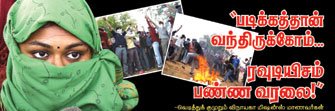 After Chennai, angry students have started an agitation in Salem as well. Students of Vinayaka Mission Deemed University's Krupananda Variyar Engineering College are demanding that their management get the necessary AICTE approvals. When Shanmuga Sundaram, Vinayaka Mission Chairman, tried to pacify the angry crowd of students, it only exacerbated the problem. There have been reports of scuffle involving hired thugs and students and subsequent Police intervention.
Following this, about 65 students have been suspended from the institution, for being at the forefront of the agitation and for questioning the Chairman. All students staying in the College Hostel have been asked to vacate their rooms. The College administration has also closed the College indefinitely.
Our reporters met the students who had gathered opposite the College, on 24th [May 2006]. "They asked us to leave the hostel yesterday night at 11.30 PM. How can we girls go anywhere so late in the night? We have been paying Rs. 20,000 per year as hostel rent. Over an above that, we pay mess fees every month. Why should we leave the hostel? Even though this is a college hostel, it has been sub-contracted to private parties. The hostel has not been functioning properly. Though this is a ladies hostel, only men have been appointed as wardens" said an angry girl.
"We didn't bother about the money, because we were hoping to get quality education here. But only after coming here we learnt that there is no quality here. None of our teachers can speak in English. They know only Tamil. But most of the students here are from Bihar, Karnataka, Andhra, Kerala and other states. The teachers teach in a mix of Tamil and English. They are not experienced in teaching either. The lab facilities are very poor. In short, though they call this a Deemed University, it is no better than a high school. We were patiently tolerating all this. But this latest AICTE problem... We can't tolerate this one. It is complete waste getting a degree not approved by AICTE. That is why we are agitating", said a bunch of students who were hiding their faces with masks.
"Chairman Shanmuga Sundaram's hired goondas have beaten us up. The local Police is entirely in his pocket. We have come from 3000 km away, not do be rowdies here, but to study. They have cut off the food in the hostel today. We do not know how we can manage", said few students from Bihar.
As more students gathered, the anger level went up as well. They started shouting slogans such as - 'We want justice, 'We demand AICTE recognition', 'Money-sucking management, also think about our future!', 'Don't unleash violence on students' and 'Cheating Chairman down down!'. As a climax, they burnt down the effigy of Chairman Shanmuga Sundaram.
In the meantime, a group of student representatives went and met Salem district Collector Mathivanan. He immediately sent a group of officials headed by an RTO. On 24th evening discussions were held in Salem RTO's office. College management representatives stated that the AICTE issue was sub-judice and the management will follow whatever the court decrees. The student representatives demanded revoking the suspension order given to the students and re-opening of the hostels. The college authories promised to re-open the hostel immediately and said if proper explanations are given by the suspended students, they will consider revoking the suspension orders. If peace persists, they said college may also be re-opened.
The District Administration announced that the College authorities will give up their vengeful attitude and the students have also agreed to co-operate in re-opening the College. But the question as to whether the student agitation will quieten down or not, still lingers.
Courtesy: Kumudham Reporter (requires free registration and login, in Tamil. Translation is mine).
=======
AICTE vs Deemed Universities - the chaos continues. A bunch of Tamil Nadu based Self-financed Engineering Colleges have obtained Deemed University status and have been taking the students for a ride. They do not follow any norms laid down by AICTE. They do not allow AICTE to inspect the college premises.
The students, it appears have been putting up with the poor quality of education, because fundamentally they do not seem to be interested in quality education either. They only want an AICTE approved degree certificate.
It may sound cruel but I almost feel like telling the students that they deserve all the shit they are getting. They should have agitated earlier when they found the quality of the education not up to the mark. When the facilities were lacking. When the teachers were found to be pathetic.
The involvement of district administration is troubling. This requires intervention from the State Education Ministry. Not the District Collector. The Collector almost always treats everything as a law and order problem. He has very little idea about the educational
issues involved.
In the previous Jayalalitha administration, no one from the state cabinet ministry was involved. It was left to AICTE to fight out the problem directly with the college administrations. At least in the new Karunanidhi regime I hope someone from the state cabinet gets involved in punishing the errant colleges.
=====
I received an email from a person in Jammu that Vinayaka Mission is offering distance education courses in Jammu and promising Engineering degrees to students who are pursuing polytechnic diplomas. There are no contact classes, practicals, or lab facilities. The 3-year course can be crashed and finished in just 1.5 years, and the students can walk away with Vinayaka Mission Deemed University "degrees".
All I can say is, Caveat Emptor!
Tuesday, May 02, 2006
Bolivia nationalises natural gas industry
In a move, widely expected after Eva Morales became the President of Bolivia, the country has announced that the foreign gas companies operating in Bolivia must re-negotiate their deals with the country within 6 months or else will be thrown out of the country, and the country will take over all the production facilities.
Only last week, Venezuela, Cuba and Bolivia have worked out a deal for economic cooperation as against US backed free-trade zone. They have called it People's Trade Agreement!
A left wing driven South America is looking to come on its own, and it is not all that bad. India must look towards engaging these countries for a fruitful economic cooperation.
Monday, May 01, 2006
Lok Paritran vs Desiya Murpokku Diravidar Kazhakam
When everyone thinks the battle in Tamil Nadu is between DMK and AIADMK, I see that it is also going to be extremely important for two other parties, both debuting in elections.
Lok Paritran aims to be an all-India party. It has registered itself with the election commission and is contesting in 7 seats in the Tamil Nadu Assembly Elections 2006. Five of the seven seats are in Chennai, with the other two being Villivakkam (Thiruvallur) and Mudukulathur (Ramanathapuram). The candidates are young, highly educated and the party aims to clean up the political junkyard. There seems to be a reasonable support for this party from several educated people - the retired middle class group which is sick of the DMK, AIADMK brand of uncouth, goonda politics as well as some young graduates.
DMDK - a party started very recently by Tamil actor Vijayakanth is more ambitious and has been preparing quite well for the last few months. It has put up its candidates - all on its own - in almost all the constituencies. This is also a registered party, but yet to be recognized and has been allotted with "Drum" as its symbol in most constituencies. It is well funded for a new party - all Vijayakanth's money and money from his fan club.
Lok Paritran frightens me with its ideology. Its website seems to have several similar phoney passages. A sample for you here:
A political party must have a well defined agenda. It must have thorough understanding of the existing condition in the country. Thankfully, the party's election manifesto is a far better document. It puts up a eight-point agenda:
I hope experiments like Lok Paritran succed in the longer term, though I am not going to vote for them in this election. They have put up a candidate for my constituency - Thousand Lights - but I can't find any information about this person in their site - their candidate list is partial and broken. Their candidate has not attempted to contact people in the constituency. I understand lack of money is may be a problem. I read somewhere that they are using Internet and emails effectively, but I am yet to receive any emails or email forwards or sms message or anything of that sort.
Vijayakanth does not claim to have a complex ideology. He wants to offer corruption-free administration. He has promised a lot of things to the poor - 15 kg of free rice a month, ration items home delivered, and several other freebies to various sections. Though he started offering all this well before the DMK, AIADMK promises, he has not found sufficient media coverage.
My guess is that both parties will lose all the seats. DMDK may possibly win one. They will lose their deposits in most of the places, if not all.
I think Vijayakanth will demonstrate his vote percentage as victory, and will continue in politics for the next 5 years at least. I am afraid Lok Paritran candidates may not show the same degree of enthusiasm. If they do, that would be wonderful.
My advice to Lok Paritran:
1. Get to the grassroots. Go to villages and small towns and stay there and work for their betterment. It is possible. You can make a huge difference.
2. It is not possible to just tap the disgruntled retired middle-class votes and win elections. Your programmmes have to be more concrete.
3. Highly educated candidates will not translate into effective administrators. Nor is it a highly desiarable characterestic. Most educated people that I know do not understand the problems facing our society.
4. Keep standing in elections at various levels. Go to panchayat elections. It is easier to explain to people and fight on simple one-point agenda - the problem of immediate concern to people.
5. Work out a detailed study of where the previous Governments have failed. Explain the same to people in simple languages. Explain how you would be different and why therefore people should vote for you.
6. Either think of a nice abbreviation or a Tamil translated name for your party in Tamil Nadu. Otherwise, you will fail. LP perhaps? Stay away from Sanskrit in Tamil Nadu.
Lok Paritran aims to be an all-India party. It has registered itself with the election commission and is contesting in 7 seats in the Tamil Nadu Assembly Elections 2006. Five of the seven seats are in Chennai, with the other two being Villivakkam (Thiruvallur) and Mudukulathur (Ramanathapuram). The candidates are young, highly educated and the party aims to clean up the political junkyard. There seems to be a reasonable support for this party from several educated people - the retired middle class group which is sick of the DMK, AIADMK brand of uncouth, goonda politics as well as some young graduates.
DMDK - a party started very recently by Tamil actor Vijayakanth is more ambitious and has been preparing quite well for the last few months. It has put up its candidates - all on its own - in almost all the constituencies. This is also a registered party, but yet to be recognized and has been allotted with "Drum" as its symbol in most constituencies. It is well funded for a new party - all Vijayakanth's money and money from his fan club.
Lok Paritran frightens me with its ideology. Its website seems to have several similar phoney passages. A sample for you here:
Reality is a continuum. Knowledge system, in shortest, is fragmentation imposed upon the continuum of reality. Fragmentation is always a necessity for understanding of the unknown. Every fragment in the knowledge system becomes a construct or an entity that is defined in the knowledge system. This very fact shows that different knowledge systems can be build on the same reality based on different possibilities and patterns of fragmentation.This is the best way to drive people away.
....
Entities are abstraction and should not be viewed as objects or elements as such, but patterns residing over continuum of reality, or in physical world, over continuum of material. So, the structure of knowledge system that is built over the patterns or entities will have a continuum of the levels of abstraction.
and so on ....
A political party must have a well defined agenda. It must have thorough understanding of the existing condition in the country. Thankfully, the party's election manifesto is a far better document. It puts up a eight-point agenda:
- eradication of corruption
- effective implementation of schemes
- transparency and accountability
- eradication of poverty and unemployment
- improved public health and sanitation
- improving the condition of farmers
- improving the level of education in the state (of Tamil Nadu)
- ensuring constituency development fund is properly spent
I hope experiments like Lok Paritran succed in the longer term, though I am not going to vote for them in this election. They have put up a candidate for my constituency - Thousand Lights - but I can't find any information about this person in their site - their candidate list is partial and broken. Their candidate has not attempted to contact people in the constituency. I understand lack of money is may be a problem. I read somewhere that they are using Internet and emails effectively, but I am yet to receive any emails or email forwards or sms message or anything of that sort.
Vijayakanth does not claim to have a complex ideology. He wants to offer corruption-free administration. He has promised a lot of things to the poor - 15 kg of free rice a month, ration items home delivered, and several other freebies to various sections. Though he started offering all this well before the DMK, AIADMK promises, he has not found sufficient media coverage.
My guess is that both parties will lose all the seats. DMDK may possibly win one. They will lose their deposits in most of the places, if not all.
I think Vijayakanth will demonstrate his vote percentage as victory, and will continue in politics for the next 5 years at least. I am afraid Lok Paritran candidates may not show the same degree of enthusiasm. If they do, that would be wonderful.
My advice to Lok Paritran:
1. Get to the grassroots. Go to villages and small towns and stay there and work for their betterment. It is possible. You can make a huge difference.
2. It is not possible to just tap the disgruntled retired middle-class votes and win elections. Your programmmes have to be more concrete.
3. Highly educated candidates will not translate into effective administrators. Nor is it a highly desiarable characterestic. Most educated people that I know do not understand the problems facing our society.
4. Keep standing in elections at various levels. Go to panchayat elections. It is easier to explain to people and fight on simple one-point agenda - the problem of immediate concern to people.
5. Work out a detailed study of where the previous Governments have failed. Explain the same to people in simple languages. Explain how you would be different and why therefore people should vote for you.
6. Either think of a nice abbreviation or a Tamil translated name for your party in Tamil Nadu. Otherwise, you will fail. LP perhaps? Stay away from Sanskrit in Tamil Nadu.
Tuesday, April 25, 2006
Politics of Subsidy
Tamil Nadu is witnessing a close contest in the 2006 Assembly Elections. In the last four assembly elections, DMK and AIADMK won alternatingly, and with thumping majority each time, thereby killing the democracy in the state.
In the recent legislature, AIADMK Chief Minister Jayalalitha came up with several controversial legislations and ordinances. There was rarely any debate. Opposition parties mostly walked out, or were bundled and thrown out, before bills were put to vote. Opposition leader Karunanidhi of DMK never once went to the assembly, except to sign the register, fearing physical attacks on him within the house. The AIADMK members and ministers started their speech praising the all powerful 'Amma' and constantly attacking and denigrating Karunanidhi and other opposition party leaders. The Speaker ensured that all such attacks stayed in the assembly proceedings but was quick to remove anything said against Jayalalitha.
The politics in general was bad and petty, each side trading charges against the other. People's welfare was given a go by. DMK, far its part, became a close and important ally in the Central Governnment and caused enough problems for the AIADMK State Government.
As the elections neared, Jayalalitha rolled back several of her tough measures and offered a lot of freebies to woo the electorate. Not to be left behind DMK came up with a mother of all manifestos. In the words of Finance Minister P.Chidambaram, "the hero of this year's election was DMK Manifesto". DMK offered the following:
Jayalalitha and her friendly parties first made fun of Karunanidhi's scheme. But seeing the kind of support the scheme had, Jayalalitha suddenly turned around and said she will offer 10 kg rice free to every ration card holder and the remaining 10 kg rice at Rs. 3.50 per kg. Thus if a family needs only 10 kgs, they do not have to pay any money at all and every kg thereafter will cost Rs. 3.50 per kg.
There was no debate in the state on whether such subsidies are needed at all, or if needed, who actually should be provided with such subsidies. Treating all ration card holders alike irrespective of their annual income and offering them rice at such low or no cost has several other ramifications.
The current rice subsidy provided by Tamil Nadu government is close to Rs. 1,500 crore an year. The additional subsidy required for Karunanidhi's scheme could be anywhere from Rs. 680 crore (Karunanidhi has used 1.5 crore ration cards and hence projects an additional outlay of Rs. 540 crore. The actual number of ration cards are 1.88 crore, and hence roughly Rs. 680 crore for an extra Rs. 1.50 subsidy per kg; 20 kg per month, per ration card.) to Rs. 1,500 crores if you look at hidden costs. Rice consumption could go up since it is offered free or at a lower cost. Current subsidy of Rs. 1,500 crore is when the per card consumption is about 170 kg per year. If this goes up to 240 kg that every card is entitled to, the subsidy cost will mount.
The free colour television sets, say 50 lakhs - one each to each family below the poverty line - could cost a lot as well. Karunanidhi proposes to source TVs from China for as low as Rs. 2,000 each. This could therefore cost 1,000 crores further. Then the invisible cost of administering the distribution of the same to the needy. Now, work out the corruption money that would be generated in the process. Already some newspapers reported that DMK cadres were going around collecting names and demanding Rs. 1,000 to include names in the list - of people who would be receiving the colour TV once DMK comes to power.
The politics of largesse will continue as long as people believe that it is perfectly okay for the Government of the day to offer them something for free, and it is okay for them to accept the same. What they do not realise is that it is all coming from their own money. Their collective money.
Do they really want the Government to get them some third rate chinese TV costing Rs. 2,000 or do they want good economic opportunities which will offer them additional revenues of over Rs. 10,000 with which they can decide to buy what TV they want? Do they want to keep buying the dubious quality rice they have been getting in the PDS or do they want to increase their buying capacity and choice of what they can buy?
It makes sense to offer subsidised foodgrains to people below the poverty line. It can be achieved by offering them subsidy coupons which they can cash in any supermarket or roadside shop. Instead we are running a bloated PDS which is corrupt to the core and offers low quality of service to its customers. Rice is constantly stolen from the PDS godowns for sale in the open market at high prices. Once, the PDS used to offer several products: Rice, Kerosene, Wheat, Sugar, Maida, Rava and so on. Today, it is just Rice and Kerosene - products with high subsidy. People buy the rest in the open markets, and most people buy rice in the open market as well. Cooking gas has replaced kerosene in most middle class and lower middle class houses and this trend will continue. Rather than actively working towards better governance and making better opportunities in education and jobs available, we are forced to hold a begging bowl by the political parties.
Party manifestos do not talk about how many schools they will build, how many kilometers of roads they will build new, how they will improve the existing roads, how they will help in increasing business opportunities, how they will encourage entrepreneurs to start new businesses, how they will work with agricultural labourors and improve their life conditions and so on. Instead what we get is empty promises which are not sustainable.
Whoever wins, the extra subsidies will be offered at best for an year. Then the conditions will become unbearable again for the poor in the subsequent years.
In the recent legislature, AIADMK Chief Minister Jayalalitha came up with several controversial legislations and ordinances. There was rarely any debate. Opposition parties mostly walked out, or were bundled and thrown out, before bills were put to vote. Opposition leader Karunanidhi of DMK never once went to the assembly, except to sign the register, fearing physical attacks on him within the house. The AIADMK members and ministers started their speech praising the all powerful 'Amma' and constantly attacking and denigrating Karunanidhi and other opposition party leaders. The Speaker ensured that all such attacks stayed in the assembly proceedings but was quick to remove anything said against Jayalalitha.
The politics in general was bad and petty, each side trading charges against the other. People's welfare was given a go by. DMK, far its part, became a close and important ally in the Central Governnment and caused enough problems for the AIADMK State Government.
As the elections neared, Jayalalitha rolled back several of her tough measures and offered a lot of freebies to woo the electorate. Not to be left behind DMK came up with a mother of all manifestos. In the words of Finance Minister P.Chidambaram, "the hero of this year's election was DMK Manifesto". DMK offered the following:
- Rice to every ration card holder at Rs. 2 a kg. Currently the PDS offers rice at Rs. 3.50
- Free colour television sets to those who do not have it
Jayalalitha and her friendly parties first made fun of Karunanidhi's scheme. But seeing the kind of support the scheme had, Jayalalitha suddenly turned around and said she will offer 10 kg rice free to every ration card holder and the remaining 10 kg rice at Rs. 3.50 per kg. Thus if a family needs only 10 kgs, they do not have to pay any money at all and every kg thereafter will cost Rs. 3.50 per kg.
There was no debate in the state on whether such subsidies are needed at all, or if needed, who actually should be provided with such subsidies. Treating all ration card holders alike irrespective of their annual income and offering them rice at such low or no cost has several other ramifications.
The current rice subsidy provided by Tamil Nadu government is close to Rs. 1,500 crore an year. The additional subsidy required for Karunanidhi's scheme could be anywhere from Rs. 680 crore (Karunanidhi has used 1.5 crore ration cards and hence projects an additional outlay of Rs. 540 crore. The actual number of ration cards are 1.88 crore, and hence roughly Rs. 680 crore for an extra Rs. 1.50 subsidy per kg; 20 kg per month, per ration card.) to Rs. 1,500 crores if you look at hidden costs. Rice consumption could go up since it is offered free or at a lower cost. Current subsidy of Rs. 1,500 crore is when the per card consumption is about 170 kg per year. If this goes up to 240 kg that every card is entitled to, the subsidy cost will mount.
The free colour television sets, say 50 lakhs - one each to each family below the poverty line - could cost a lot as well. Karunanidhi proposes to source TVs from China for as low as Rs. 2,000 each. This could therefore cost 1,000 crores further. Then the invisible cost of administering the distribution of the same to the needy. Now, work out the corruption money that would be generated in the process. Already some newspapers reported that DMK cadres were going around collecting names and demanding Rs. 1,000 to include names in the list - of people who would be receiving the colour TV once DMK comes to power.
The politics of largesse will continue as long as people believe that it is perfectly okay for the Government of the day to offer them something for free, and it is okay for them to accept the same. What they do not realise is that it is all coming from their own money. Their collective money.
Do they really want the Government to get them some third rate chinese TV costing Rs. 2,000 or do they want good economic opportunities which will offer them additional revenues of over Rs. 10,000 with which they can decide to buy what TV they want? Do they want to keep buying the dubious quality rice they have been getting in the PDS or do they want to increase their buying capacity and choice of what they can buy?
It makes sense to offer subsidised foodgrains to people below the poverty line. It can be achieved by offering them subsidy coupons which they can cash in any supermarket or roadside shop. Instead we are running a bloated PDS which is corrupt to the core and offers low quality of service to its customers. Rice is constantly stolen from the PDS godowns for sale in the open market at high prices. Once, the PDS used to offer several products: Rice, Kerosene, Wheat, Sugar, Maida, Rava and so on. Today, it is just Rice and Kerosene - products with high subsidy. People buy the rest in the open markets, and most people buy rice in the open market as well. Cooking gas has replaced kerosene in most middle class and lower middle class houses and this trend will continue. Rather than actively working towards better governance and making better opportunities in education and jobs available, we are forced to hold a begging bowl by the political parties.
Party manifestos do not talk about how many schools they will build, how many kilometers of roads they will build new, how they will improve the existing roads, how they will help in increasing business opportunities, how they will encourage entrepreneurs to start new businesses, how they will work with agricultural labourors and improve their life conditions and so on. Instead what we get is empty promises which are not sustainable.
Whoever wins, the extra subsidies will be offered at best for an year. Then the conditions will become unbearable again for the poor in the subsequent years.
Thursday, April 13, 2006
CBSE withdraws free education to single girl child
Last year (around October 2005), CBSE floated a move to force all private schools affiliated to it to waive off fees to those girls styding from 6th standard onwards provided they were single child for their families.
The schools were asked to fend for themselves, possibly by increasing the fees of other students - boys or girls - who do not fit into the above category.
There was no debate, no discussion. Just a fiat.
The opposition to the above move was mostly muted, barring a few in Chennai which talked about moving to Tamil Nadu Matriculation syllabus.
CBSE (and its boss human resource development ministry) just moved on, without a care in the world, and amended the bylaws in November 2005, making the fee waiver a requirement from the educational year 2006-07.
A Delhi based minority institution Carmel Convent School approached Delhi High Court to quash the circular issued by CBSE stating that it impinged on Article 30 of the Constitution allowing minorities infettered administrative control over their educational institution. The Delhi High Court stayed the circular. No mainstream non-minority private school approached courts, however.
CBSE then seems to have modified its position in the Delhi High Court and suggested that rather than enforcing the fee waiver, they would suggest a scholarship scheme, whereby any school that charges more than Rs. 1,000 per month as fees would offer scholarships to the single girl child, provided she secures more than 60% marks. The court accepted this and dismissed the petition from Carmel Convent School but allowed the school to appeal again if the school thought this policy was also of problem to it.
Then, quietly, prompted by the human resource development ministry, CBSE seems to have withdrawn the circular. The reason stated is a legal opinion obatined by the ministry "in the wake of fierce opposition from private school managements". I missed this news item but heard about it only now. I am blogging it here for completion.
A victory nevertheless for private enterprises from needless meddling by inept governments and their extensions!
If the government really wants to promote low cost, quality education to girl children (or boys!), they can do so by empowering more private enterprises to start schools all over and then regulate the schools to ensure that they provide acceptable quality education.
Friday, April 07, 2006
BCCI's revenue overdrive
The BCCI management, driven primarily by its vice-president Lalit Modi comes up with innovative revenue generation moves.
Until now, cricket boards organized matches in their home countries and generated Television revenue, Tournament and ground sponsorship revenue, ticketing revenue and so on. When they toured abroad, they were paid a guarantee money by the host country.
When ICC started organizing world cups and other tournaments, they paid the particpating countries a decent share of the overall revenue generated.
In between, companies like IMG or CBFS of Sharjah organized tournaments in Toronto and Sharjah. They entered into arrangements with Indian, Pakistani and other cricket boards, paid some monies to the boards and pocketed the rest.
Now, Lalit Modi wants to organize India-Pakistan matches in neutral venues with large expatriate Indian (and Pakistani) population. Besides Pakistan, it looks like other countries may also participate. There are a couple of matches to be held next month in Abu Dhabi between India and Pakistan - back to back.
BCCI has sold the global broadcast rights to these matches to Zee Sports. For a minimum of 25 one-day Internationals, the cost of the global rights comes to a whopping US$ 219.15 million! This number looks like complete madness to me.
But then, all the monies BCCI has been getting in the last few weeks seems to be sheer madness.
Admittedly BCCI will have costs - revenue sharing with other touring teams (or at least some guaranteed money), stadium rentals (which could be offset with the gate collections), cost of creating television footage for the events and so on. Despite all this, BCCI will be left with a sizeable chunk of money.
A sponsor for these tamasha matches will pour further monies in. There will be other merchandising opportunities.
One can't appreciate the smartness of Mr. Modi enough, but for his arrogant attitude. From all accounts I hear, the man is a thorough pest and unmanageable. He throws temper tantrums and acts in the most despicable manner. Even in the recent Zee's winning bid, Zee is talking about filing a defamation suit against Lalit Modi for using intemperate and abusive language at Zee's CEO.
I am glad that I got out of the cricket business before coming face to face with Mr. Modi!
At least on the inter-personal relationship angle, Lalit Modi makes Dalmiya look like an angel.
Subscribe to:
Posts (Atom)